
Blog
-

How to Deploy an Application to a Managed Kubernetes Cluster with Helm, Ingress, and TLS
Deploying an application to managed Kubernetes requires a ready-to-use container image, kubectl access to the cluster, Helm, an Ingress Controller, a domain, and TLS.
-

How to Mount S3-Compatible Object Storage on Linux with rclone
-

How to Use the AWS CLI with S3-Compatible Object Storage: Uploading, Synchronization, and Access Permissions
To connect the AWS CLI to a third-party provider's S3-compatible Object Storage, you need four key parameters:
-

How to Increase a VPS Disk and Expand ext4, XFS, or LVM on Linux
After expanding the disk in the provider's control panel, the additional space may not be immediately available within Linux. First, you need to determine which layer still reports the old...
-

How to Add a Swap File to an Ubuntu VPS and Configure Swappiness
On an Ubuntu VPS, you can add swap as a regular file without creating a separate disk partition.
-

How to Configure the UFW Firewall on Ubuntu Without Losing SSH Access
A basic UFW configuration for a remote Ubuntu server looks like this:
-

How to Deploy a Django Application on Ubuntu with Gunicorn, PostgreSQL, Nginx, and SSL
For a production Django deployment, python manage.py runserver alone is not sufficient. In a production setup, Django handles the application logic, PostgreSQL stores...
-

How to Install MySQL on Ubuntu: Secure Configuration, Remote Access, and Backups
Welcome, dear reader!
-

How to Configure an Nginx Reverse Proxy on Ubuntu with HTTPS and WebSocket Support
In this guide, we will configure Nginx on Ubuntu as a reverse proxy between a domain and an application running on a local port, such as 127.0.0.1:3000.
-

How to Install and Configure Docker on Ubuntu 24.04/26.04 LTS
In this guide, we will install Docker Engine on Ubuntu 24.04/26.04 LTS from Docker’s official repository, verify that the daemon is running, and launch a hello-world test container.
-

How to Build a Fault-Tolerant Web Application with Two Virtual Machines and a Load Balancer
A fault-tolerant web application can be built using two identical application servers in the same private network and a Load Balancer that accepts external requests...
-

How to Create OpenStack Cloud Infrastructure with Terraform
Terraform lets you describe OpenStack cloud infrastructure as code and manage its lifecycle using a single set of commands. Instead of manually creating resources in the control panel, you can...
-

How to Set Up Website and API Monitoring with Uptime Kuma on a VPS
Uptime Kuma is a self-hosted monitoring system that you can deploy on your own VPS and use to check websites, APIs, and network services. It supports HTTP(S), TCP, keyword checks, public...
-

How to Set Up VPS Monitoring with Prometheus, Grafana, and Node Exporter
Prometheus, Grafana, and Node Exporter let you build a complete VPS monitoring system without relying on external SaaS services. Node Exporter provides server system metrics,...
-

How to Configure VPS Backups to S3-Compatible Storage with Restic
For reliable VPS backups, it is not enough to store the only backup archives on the same server: if a disk fails, the VPS is deleted, or the system is compromised, you can lose both...
-

How to Set Up Automated Deployment to a VPS with GitHub Actions or GitLab CI/CD
Zero-downtime deployment can be built around a releases directory and a current symbolic link: the new version of the application is uploaded to a separate directory and...
-

How to Deploy a FastAPI Application on a VPS with PostgreSQL and Nginx
A FastAPI application can be deployed on a VPS as a full-fledged production service: install Python and the required dependencies, connect PostgreSQL, configure migrations, run the...
-

How to Deploy a Node.js Application on a VPS with PM2, Nginx, and SSL
In this guide, we will deploy a small Node.js application on a VPS and prepare it for production: install Node.js LTS, create a dedicated system user, and configure environment...
-

How to Install Coolify on a VPS and Deploy an Application from a Git Repository
In this guide, we will install Coolify on a VPS and deploy a test application directly from a Git repository. Then we will configure a domain, HTTPS, environment variables,...
-

How to Install PostgreSQL on a VPS: Security, Remote Access, and Backup
In this guide, we will install PostgreSQL on a VPS, create a dedicated database and user, and then configure secure remote access, backups, and a few basic performance settings.
-

How to Host Multiple Websites on a Single VPS with Nginx Proxy Manager
In this guide, we will deploy two demo websites on a single VPS and configure routing to them through Nginx Proxy Manager. Both applications will run in Docker containers and share an...
-

How to Deploy Nextcloud on a VPS with PostgreSQL, Redis, and HTTPS
Nextcloud can be deployed on a VPS with Docker Compose by separating the application, PostgreSQL, Redis, and cron background tasks into individual containers. This approach simplifies...
-

How to Install Portainer on a VPS and Manage Docker Containers
Portainer is a web-based dashboard for managing Docker containers, images, networks, volumes, and Docker Compose stacks without having to work constantly from the command line. In this guide,...
-

How to Deploy a Docker Compose Application on a VPS with Nginx and SSL
In this guide, we will deploy a small web application on a VPS running Ubuntu 24.04 using Docker Compose. The application will run inside a container, while Nginx will accept external...
-

How to Install WordPress on a VPS with Nginx, MariaDB, Redis, and SSL
In this guide, we will deploy WordPress on a virtual machine running Ubuntu 24.04. The deployed configuration will include Nginx, PHP-FPM, MariaDB, Redis Object Cache, a domain, and a...
-

How to Host a Telegram Bot on a VPS: Python/Node.js, systemd, Docker, Webhook, and HTTPS
A Telegram bot can be run on a VPS in two main ways: with polling or with a webhook. For a simple project, a personal bot, or a small MVP, a polling bot managed by...
-

How to Install n8n on a VPS: Docker Compose, Domain, SSL, and PostgreSQL
It is better to deploy n8n on a VPS not as a single ad hoc container, but as a small self-hosted architecture: VPS, Docker Compose, n8n, PostgreSQL, a reverse proxy, a domain, SSL,...
-

What to Do If a Website Won't Open After Moving to a VPS: DNS, SSL, Firewall, Nginx, and the Database
If a website does not open after being moved to a VPS, troubleshoot the issue layer by layer. Do not start changing every setting at once: first check...
-

502 Bad Gateway Error on a VPS: What to Check in Nginx, PHP-FPM, Node.js, and Docker
Error 502 Bad Gateway usually means that the reverse proxy received an invalid response from the upstream service or could not reach it. On a VPS, this proxy is most often...
-

How to Back Up a Website on a VPS: Files, Database, Schedule, and Recovery
A website backup on a VPS is not just a single archive in the /backup folder. A proper backup strategy answers five questions: what to back up, where to store it, how often to run...
-

Why Website Emails Go to Spam: A Checklist for VPS, WordPress, and Online Stores
If emails from your website are going to spam, the problem is not always the email content or the form on the website. Delivery depends on the entire chain: the domain, DNS...
-

How to Configure Email on a VPS: Domain, SMTP, SPF, DKIM, DMARC, and PTR
Email on a VPS depends on more than just a mailbox and an SMTP server. For messages to reach the inbox, the domain, DNS records, IP address, and server configuration must look...
-

Why SSL Isn’t Working: Expired Certificate, Mixed Content, Redirect Loop, and DNS Errors
If SSL isn’t working, first identify the symptom. Different errors may look similar to users, but they are fixed in different places: DNS, the certificate, the web...
-

How to Install an SSL Certificate on a VPS: Let’s Encrypt, Certbot, and Automatic Renewal
An SSL certificate on a VPS is not installed “on the server as a whole,” but for a specific domain or subdomain. Before a certificate can be issued, the domain must...
-

VPS Control Panel: HestiaCP, CyberPanel, aaPanel, or No Control Panel
Not every VPS needs a control panel. A panel makes it easier to manage websites, domains, SSL, email, databases, users, and backups, but it is not a substitute for proper server...
-

Nginx or Apache for a Website on a VPS: What to Choose in 2026
In 2026, Nginx, Apache, an Nginx + Apache setup, and OpenLiteSpeed should be chosen not based on which one is “faster overall,” but for the specific website, CMS, and stack.
-

VPS for an online store: what kind of server you need for WooCommerce, OpenCart, or PrestaShop
A VPS for an online store should be chosen with headroom. Unlike a regular website, an online store constantly works with dynamic pages and functions: the cart,...
-

Why a Website Is Slow: How to Tell Whether the Problem Is the VPS, Database, CMS, or Code
If a website is slow, you should not immediately upgrade your VPS plan or install yet another optimization plugin. First, determine exactly where the delay occurs: on...
-

How to Speed Up WordPress on a VPS: Nginx, PHP-FPM, Redis, Cache, and CDN
Speeding up WordPress on a VPS should start with diagnostics, not with installing yet another caching plugin or upgrading the plan. One site may be slow because of an underpowered...
-

How to Choose a VPS for WordPress in 2026: RAM, PHP, MySQL, Caching, and Security
You should not choose a VPS for WordPress based only on the number of visitors or generic CMS requirements. At the same traffic level, a blog with full-page caching and an...
-

How to migrate a website from shared hosting to a VPS without losing traffic or rankings
Migrating a website from shared hosting to a VPS is best handled not as a single action, but as a sequence of checks. The main goal is to preserve site availability,...
-

How to Connect to a VPS via SSH: Instructions for Windows, macOS, and Linux
To connect to a VPS via SSH, you usually need four things:
-

What to Do After Buying a VPS: Initial Server Setup on Ubuntu 26.04 LTS
After buying a VPS, you should not immediately install a website, database, or control panel. First, update the system, disable unnecessary login methods, configure the firewall,...
-

How Much a VPS Really Costs: Plan, IP Address, Backups, Control Panel, Traffic, and Administration
The cost of a VPS is not just the amount shown on the plan card. The base rental fee is often supplemented by backups, a control panel, additional IP...
-

How to Choose a VPS for a Website: CPU, RAM, NVMe, Traffic, and Region in Simple Terms
When choosing a VPS, the most important factor is not the highest numbers in the plan, but how well the configuration matches the actual workload. A small website may be...
-

VPS and VDS: what’s the difference, and which should you choose for a website, online store, or application?
Across different providers, VPS and VDS often refer to the same type of service: a virtual server with its own operating system, custom settings,...
-

VPS or standard hosting: which should you choose for your website in 2026?
Standard hosting is usually enough for a landing page, a small blog, a brochure website, or a simple online store built on a popular CMS. It is cheaper, easier to manage, and does...
-

LLMOps in the Cloud in 2026: Model Versioning, Prompt Management, Observability, and Cost per Token
By 2026, LLMOps in the cloud is not about connecting a model via an API, but about managing the entire response pipeline: data, the prompt, the model,...
-

Cloud tagging, budgets, and chargeback: how to allocate costs by project and avoid runaway costs
Cloud costs become a problem not when the bill arrives, but when resources are created without a clear owner, project, environment, or cost center. Tags alone...
-

S3 Lifecycle and storage classes: how to reduce object storage costs without data loss
S3 cost savings do not come from mechanically moving “everything old” to Glacier, but from policies aligned with the role of the data. It is important to understand how...
-

Point-in-Time Recovery for Cloud Databases: How PITR Works and When It Is Needed
PITR (Point-in-Time Recovery) is typically needed not for a routine infrastructure failure, but for logical data corruption: an accidental DELETE, DROP TABLE, a failed...
-

Managed PostgreSQL vs. PostgreSQL on a VPS: choosing based on cost, SLA, backups, and control
Choosing between Managed PostgreSQL and PostgreSQL on a VPS is not a comparison between an “expensive” and a “cheap” plan; it is a decision about where...
-

Snapshots vs. Backups vs. Replication: What Really Protects Data in the Cloud
Snapshots, backups, and replication protect against different risks. A snapshot helps you quickly roll back to a point in time, a backup is used to restore a previous state, and...
-

Disaster Recovery in the Cloud: RTO/RPO, Pilot Light, Warm Standby, and a DR Plan for SMBs
Disaster Recovery in the cloud for SMBs does not start with choosing the “most reliable” architecture, but with two business questions: how much downtime the company...
-

DDoS Protection in the Cloud: L3/L4/L7, Anycast, Rate Limiting, and a Response Plan
When a service starts returning 5xx errors, latency increases, and the CDN reports anomalous traffic, the first mistake is to turn everything on—or, conversely, turn...
-

Confidential Computing in the Cloud: TEE, Confidential VM, and Attestation for Sensitive Data
Disk encryption, TLS, and KMS provide strong protection for data at rest and in transit, but they do not address the entire issue. During computations, data still...
-

Cloud KMS, BYOK, and HYOK: Managing Encryption Keys in the Cloud
Data in AWS, Google Cloud, or Microsoft Azure is often encrypted by default. However, for audits and regulated data, that answer is usually not enough. It is more important to understand not...
-

Cloud Web Application Firewall: L7 protection, OWASP Top 10, bot protection, and APIs
A cloud WAF (Web Application Firewall) is not a “shield that covers all application security,” but a managed control layer for HTTP/HTTPS traffic. It operates at Layer 7...
-

Cloud DNS private zones, split-horizon DNS, TTL, and DNS failover for cloud infrastructure
In cloud infrastructure, DNS manages not only names but also, indirectly, the actual path traffic takes. The same app.example.com name can direct an external user to...
-

Optimizing Kubernetes Costs: Requests/Limits, Quotas, Spot Nodes, and Rightsizing
In Kubernetes, even an “underutilized” cluster can be expensive. kubectl top and Grafana show actual CPU and memory consumption, but the scheduler places Pods based not on...
-

Service Mesh in Kubernetes: Istio, Linkerd, or Cilium — When the Business Needs It
A service mesh is not a mandatory next step after Kubernetes, nor is it a universal improvement to add “just in case.” It is needed when internal calls between services...
-

Kubernetes Networking 101: Service, Ingress, Gateway API, and NetworkPolicy
In Kubernetes, networking is best understood as several layers rather than a single “network object.” Pods are constantly changing: they are recreated, receive new IP addresses,...
-

Kubernetes Autoscaling in 2026: HPA, VPA, KEDA, Cluster Autoscaler, and Karpenter
Autoscaling in Kubernetes does not operate at a single layer. HPA, VPA, KEDA, Cluster Autoscaler, and Karpenter solve different problems: some change the number of pods,...
-

GitOps in Kubernetes: Argo CD vs. Flux for Deploying Cloud Applications
GitOps changes not the deployment command, but the Kubernetes management model. Git becomes the source of truth: it stores the desired state, while a controller in the cluster compares...
-

SBOM and container image signing: Cosign, Sigstore, and supply chain security in the cloud
Kubernetes should not receive just an image with a familiar name like app:1.2.3, but a verified artifact: one with an immutable digest, a software bill of materials,...
-

Policy as Code in the Cloud and Kubernetes: OPA, Gatekeeper, Conftest, and Guardrails
Policy as Code is an approach to defining infrastructure and security requirements as code: versioned, verifiable, and enforced automatically. Instead of relying on a...
-

Secrets Management in the Cloud: Vault, Secrets Manager, and Kubernetes Secrets Without Leaks
Secrets management is not about choosing “Vault or Secrets Manager”; it is about controlling the entire secret lifecycle: creation, storage, delivery to the...
-

Cloud Landing Zone in 2026: accounts, networks, IAM, guardrails, and policies for a secure start
A Cloud Landing Zone is a prebuilt foundation for launching projects securely in the cloud. It is not just a set of servers, networks, and accounts, but a...
-

How to Evaluate a Cloud Provider Before Migration: Technical Due Diligence for CTOs
Technical due diligence is not about checking the cloud provider’s storefront. It is about testing real scenarios: what happens during peak load, an outage, data recovery,...
-

Cloud Infrastructure for Medical Data: Encryption, Access Control, Regions, and Provider Requirements
Medical data can be stored in the cloud, but a cloud environment cannot be assessed only by the provider’s name, the selected region, or enabled...
-

RAG Infrastructure in the Cloud: Where to Place the Vector Database, Object Storage, API, and Models
RAG infrastructure should not be designed only around the LLM or the vector database. In a production system, the entire data path matters: where documents...
-

How to Choose a GPU Cloud for Inference: Latency, VRAM, Batching, Cold Start, and Token Cost
A GPU cloud for inference should not be chosen only by GPU-hour price, card name, or VRAM capacity. An instance may run an LLM successfully in a test and look...
-

EU Data Act and Cloud Data Portability: What Changes for Companies Using European Clouds
The EU Data Act has applied since September 12, 2025, so for companies using European cloud services, it is no longer a future reform but an active regulatory context....
-

Immutable Backup in the Cloud: Object Lock, WORM Storage, and Protection Against Admin Deletion
A backup is only useful if it can be restored after an incident. If a backup can be deleted with the same permissions used to manage the production environment,...
-

Data Transfer Costs: Why Outbound Cloud Traffic Becomes a Hidden Expense
Sooner or later, every company reaches a point where its infrastructure needs to be reassessed: moving a service, adding a backup environment, connecting a new region, changing...
-

Cloud Repatriation: When It Makes Sense to Move Some Workloads from the Cloud to Dedicated Servers or a Private Cloud
In 2026, almost every digital business needs infrastructure to run its website, application, API, database, analytics, integrations, and...
-

How to Calculate the Real Cost of Cloud Infrastructure: VMs, Traffic, Disks, Backups, IPs, and Support
A team budgets for two VMs, selects a region in a calculator, and gets a reasonable monthly estimate. After the first billing period, the invoice...
-

Google Cloud Alternatives: Where to Migrate After GCP and What to Consider When Choosing a Platform
After Google Cloud, companies usually start looking for an alternative not because “the cloud has become bad,” but because the starting point itself has...
-

Why Companies Leave GCP: Cost, Limitations, and Dependence on the Google Ecosystem
Companies usually leave GCP not because of one big problem, but because of a combination of three things: the bill becomes less predictable, platform limitations begin to...
-

Azure vs Alternative Cloud: Why Companies Look for a Replacement for Microsoft Azure
When companies start looking for a replacement for Microsoft Azure, the reason is usually not one big problem, but a combination of several things: the platform becomes...
-

Leaving Azure: Pros, Cons, and Hidden Pitfalls for Business
Leaving Azure does not automatically make a business better off. The benefit appears only when the new setup provides clearer economics, less unnecessary complexity, and more control over how the...
-
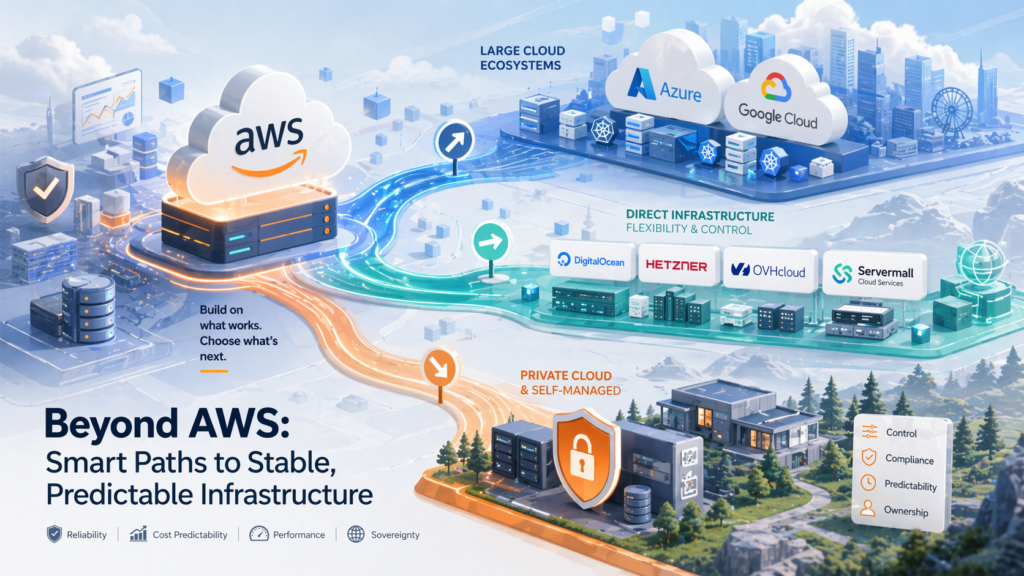
AWS Alternatives: What to Choose After Amazon Web Services for Stable and Predictable Infrastructure
After AWS, companies are usually not looking for “just another big cloud,” but for a clearer and more predictable infrastructure model.
-

Why Companies Move Away from AWS: Hidden Costs, Vendor Lock-In, and Budget Scaling Problems
Companies usually start thinking about moving away from AWS not because of one single reason, but because of a combination of three problems: hidden costs, growing...
-

How to Leave AWS Without Downtime: Key Migration Challenges and Common Mistakes
Leaving AWS without downtime is usually difficult not because of the move itself, but because the team has to hold three things together at the same time: consistent data, a...
-

Migrating from Google Cloud Platform: Key Stages, Challenges, and Business Risks
Migration from Google Cloud Platform is rarely just a matter of moving data and services out. Usually, it is not one step, but a chain of three stages: first, you need to...
-

Migrating from Microsoft Azure: What Problems Arise When Moving Services and Data
Migration from Azure is rarely just a matter of moving services and data from one place to another. The real problem is usually different: together with applications and...
-

Migrating from AWS: Pros, Cons, Risks, and When Moving Actually Makes Sense
The topic of migration has become more practical than it used to be. Since March 2024, AWS has had a program that allows customers to request free data transfer out through support...