
After Google Cloud, companies usually start looking for an alternative not because “the cloud has become bad,” but because the starting point itself has changed. Costs may have grown, control requirements may have shifted, the product may have become simpler or, on the contrary, more complex, or the team’s pace and infrastructure priorities may have changed.
Most often, it looks like this:
- The company used to need a broad cloud stack, but now clearer and calmer infrastructure matters more.
- The platform once matched the project’s scale well, but has now become heavier than the tasks themselves.
- Or the business originally wanted a wide set of services “for future growth,” but now wants to understand costs better, navigate the environment faster, and depend less on the surrounding ecosystem.
This creates the main fork.
If the company still needs a large cloud world with a broad ecosystem, it usually looks toward Azure or AWS.
But if the business cares more about a direct infrastructure layer — virtual machines, networks, Kubernetes, storage, and less platform heaviness — the focus often shifts toward DigitalOcean, Hetzner, OVHcloud, or Servermall Cloud Services.
That is why the question after GCP is not “which provider is better in general,” but which infrastructure model best matches what the business has become now.
Below, we will look at how a large cloud stack differs from a more direct infrastructure model, and how to understand which type of platform is right for you.
Azure and AWS: For Those Who Still Need a Large Cloud Stack

If, after Google Cloud, the business still wants to stay in the world of large cloud platforms, the choice most often narrows down to two directions: Azure and AWS.
These are not “simpler versions of GCP.” Rather, they are platforms with a different logic, but still with a large service set, global infrastructure, and a heavy platform ecosystem around them.
At a practical level, the difference usually feels like this:
| What matters after Google Cloud | Azure | AWS |
| Broad service ecosystem | More strongly associated with the Microsoft stack and corporate environment | More strongly associated with the widest cloud service catalog |
| Hybrid and enterprise scenarios | Often feels more natural for companies with Windows, Microsoft 365, and corporate infrastructure | More often chosen where the company needs the broadest selection of cloud services and mature patterns |
| Data, analytics, AI, and complex platform scenarios | Yes | Yes |
| General platform feel | More corporate and ecosystem-oriented | More cloud-native by default, with a stronger service-oriented feel |
This table is not about who is “better in general.” It is there to make the type of choice visible.
In both cases, the company remains inside the large-cloud world. What changes is the ecosystem, the platform’s emphasis, and how daily infrastructure work will feel.
When This Kind of Move Actually Makes Sense

This path is usually chosen not by companies that want to radically simplify infrastructure, but by those that still need a large cloud stack — just with a different ecosystem and a different operating logic.
In other words, Azure and AWS make sense where the company still wants to keep a broad set of ready-made services, global scale, hybrid scenarios, and the ability to build not only IaaS, but also a more complex platform layer.
But there is an important caveat here. If the business is leaving Google Cloud not because of Google-specific issues, but because it is tired of the large-cloud model itself, this kind of move may not simplify daily life. It may only change the scenery.
DigitalOcean, Hetzner, OVHcloud, and Servermall Cloud Services: When a More Direct Infrastructure Layer Matters More
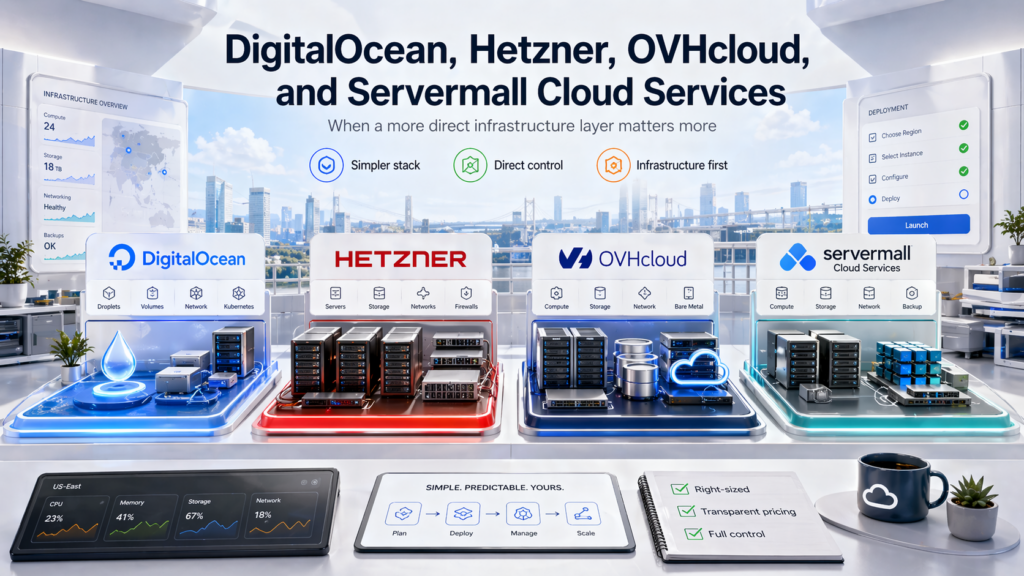
This group of alternatives is usually interesting for a completely different reason. Companies look here not when they need a new hyperscaler, but when they want to remove excess platform heaviness and return to a clearer infrastructure logic.
In other words, this is no longer about “another big cloud.” It is about a more direct model: virtual machines, networks, Kubernetes, storage, load balancers, and a more readable environment without an overly heavy ecosystem around it.
Companies usually start looking at these options when they care more about:
- Quickly understanding which blocks the service is built from
- Calculating costs more easily and explaining them inside the team
- Staying closer to networking, VMs, Kubernetes, and storage
- Depending less on large platform logic
- Getting calmer and more predictable operations
Each of these platforms has its own emphasis.
DigitalOcean is usually perceived as a friendlier and more understandable entry point into cloud infrastructure. It fits teams that need Kubernetes, virtual machines, and a solid API layer, but do not want every task to come with another floor of cloud complexity.
Hetzner more often attracts teams that want a more direct and stricter infrastructure model. There is less of a “large ecosystem” feeling and more of a sense that you are working closer to the resources themselves.
OVHcloud is usually considered where not only VMs and networking matter, but also a more structured infrastructure logic around private cloud, hybrid cloud, and control over environment placement.
Servermall Cloud Services fits a similar scenario: when the business does not need a giant platform world, but a clearer set of infrastructure blocks — virtual machines, Kubernetes, networks, storage, and related services — from which it can build a working environment for its own task.
So this group is interesting not because of “smaller names,” but because of a different kind of promise. Here, the company is usually buying not scale for the sake of scale, but simplicity, directness, and a stronger sense of control.
Which Type of Platform Fits You After Google Cloud


At this point, it makes more sense to look at the choice not through brand names, but through the type of environment the business will actually have to live with every day afterward.
If the company still needs a broad set of services, global scale, complex platform scenarios, and is ready to build a large cloud ecosystem around the product, then it usually makes more sense to stay in the hyperscaler world and choose between Azure and AWS. Azure presents itself as an open and flexible cloud platform, while AWS positions itself as global infrastructure with a broad range of cloud services.
If, on the other hand, the business cares more about something else — a more direct layer of virtual machines, networking, Kubernetes, storage, and less platform heaviness — then the choice usually shifts toward infrastructure-focused alternatives. DigitalOcean describes Droplets as Linux virtual machines, while OVHcloud emphasizes public cloud, compute, storage, and networking resources. With Servermall Cloud Services and similar providers, the logic also reads as infrastructure-first rather than “yet another huge ecosystem.”
If you reduce it to a simple fork in the road, it looks like this:
| What the business actually needs | What that usually means |
| A large cloud ecosystem, a broad service stack, and comfort with platform logic | It usually makes more sense to look at Azure or AWS |
| A calmer, more understandable environment where infrastructure is easier to calculate, maintain, and explain | It usually makes more sense to look at DigitalOcean, Hetzner, OVHcloud, or Servermall Cloud Services |
| Private cloud, hybrid cloud, and more explicit control over placement and networking | Companies more often look at OVHcloud and similar infrastructure-focused options |
| A direct IaaS layer with VMs, networking, and Kubernetes without extra platform heaviness | Companies more often choose DigitalOcean, Hetzner, or Servermall Cloud Services |
This is where the most useful post-GCP question appears: do you need another big provider, or do you need a simpler and more predictable infrastructure model?
And if the answer is already leaning toward the second option, then the comparison should no longer be about “who is louder in the market,” but about which environment will be easier for the team to live with six months after the migration.
Conclusion

Changing from Google Cloud is rarely necessary simply because the company wants to “try something different.” Usually, it becomes relevant when the business’s infrastructure requirements themselves have changed.
Some companies still need a large cloud stack with global scale, a broad service set, and complex platform scenarios. For them, it is more natural to look toward Azure or AWS.
Others care more about a direct and predictable infrastructure layer — with understandable VMs, networks, Kubernetes, and less platform heaviness. In that case, attention shifts toward DigitalOcean, Hetzner, OVHcloud, or Servermall Cloud Services.
So the final question is better phrased this way: after GCP, do you need another major provider — or do you need a different way of living with infrastructure?
The more honestly the business answers that before migration, the lower the chance of dragging old problems into the new environment.
FAQ
If you still need a large service stack after Google Cloud, does that automatically point to Azure or AWS?

Most often, yes, because they remain the most obvious alternatives in the major cloud platform category. Azure presents itself as an open and flexible cloud platform, while AWS positions itself as global cloud infrastructure with a broad range of services.
What question best brings the platform choice back down to earth?
Not “who is cheaper at the start,” but “where will the team have an easier life six months from now?” This question exposes the real difference between a large cloud stack and a more direct infrastructure model.
Are DigitalOcean and Hetzner only for small projects?
Not necessarily. But they are more clearly read as options for teams that care about simple virtual machines, APIs, a more direct infrastructure layer, and less platform heaviness around basic tasks. DigitalOcean describes Droplets as simple and scalable virtual machines, while Hetzner is often chosen as a more direct VM layer.
How do you understand that the business needs not a new vendor, but less cloud as such?
Usually, it is visible through the symptoms: the irritation is not with a specific interface, but with the multilayered environment itself, hidden supporting infrastructure, bill complexity, and constant dependency on platform logic. Then the problem is no longer the brand, but the infrastructure model itself.
Why look at OVHcloud or Servermall Cloud Services if the giants exist?
Because not every business needs a giant. OVHcloud emphasizes public cloud, compute, storage, networking, and a predictable cost model, while Servermall Cloud Services focuses on clearer infrastructure blocks such as VMs, Kubernetes, networks, and storage. For a business that wants more control and less ecosystem heaviness, that may matter more than scale for scale’s sake.
Is there a risk that after leaving GCP, I simply exchange one complexity for another?
Yes, and this is one of the most common mistakes. If the company is tired not of Google specifically, but of the heavy-cloud model itself, moving to another hyperscaler may do little to simplify daily work. In that case, the right choice is not “the next big name,” but a different type of platform.


