
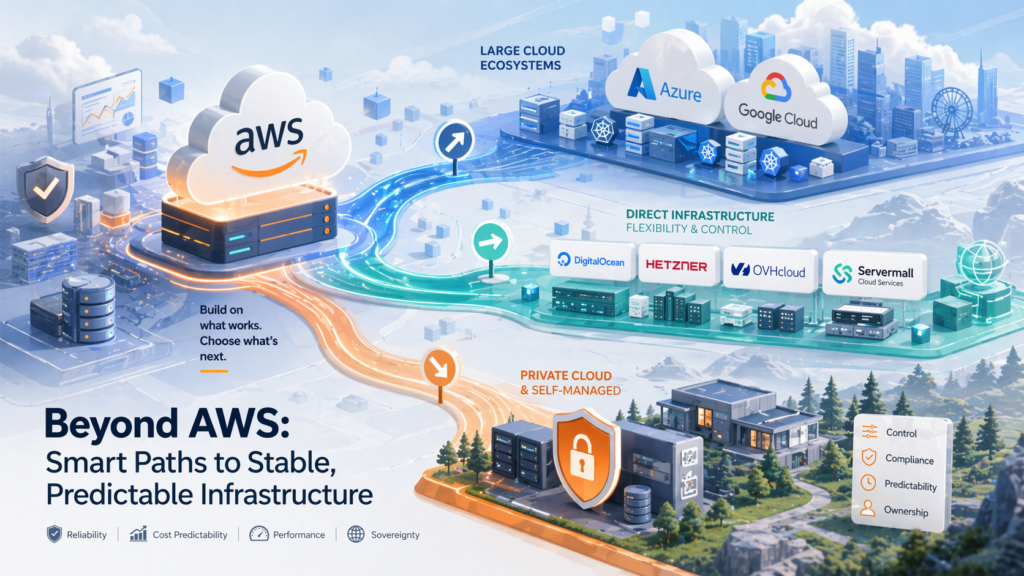
After AWS, companies are usually not looking for “just another big cloud,” but for a clearer and more predictable infrastructure model.
For some, that means staying in the hyperscaler world and looking toward Azure or Google Cloud. For others, it means the opposite: moving to a more direct infrastructure layer with virtual machines, Kubernetes, networking, and storage, but without an overly heavy platform ecosystem. Azure is positioned as a broad cloud platform, Google Cloud as a cloud with a strong focus on data and modernization, while DigitalOcean promotes itself as a simpler alternative to the major clouds.
Here is the choice in a simple table:
| If after AWS you care more about… | Where companies usually look |
| A large service stack and global scale | Azure or Google Cloud |
| A simpler and more direct infrastructure layer | DigitalOcean, Hetzner, OVHcloud, Servermall Cloud Services |
| Private cloud, hybrid cloud, and more control | OVHcloud and Servermall Cloud Services |
| Clear VMs, networks, Kubernetes, and less platform heaviness | DigitalOcean, Hetzner, Servermall Cloud Services |
The main fork is simple. If the business still needs a large cloud world, just not AWS, then it usually compares Azure and Google Cloud.
But if the goal is to move away from excessive complexity, regain a sense of control, and get more predictable infrastructure, attention more often shifts toward DigitalOcean, Hetzner, OVHcloud, and Servermall Cloud Services. Servermall Cloud Services focuses on virtual machines, Kubernetes clusters, storage, and load balancers. DigitalOcean separately emphasizes simplicity and predictability as an alternative to the major clouds.
Below, we will look at why companies after AWS start searching for something simpler than hyperscalers, how more infrastructure-oriented alternatives differ from large clouds, and which provider type usually fits different scenarios.
Why Companies Start Looking for Something Simpler After AWS

If you are reading this article, you probably already have reasons to consider changing providers. Maybe the bill is frustrating. Maybe the platform has become too heavy for the current project. Or maybe there is simply a growing feeling that the infrastructure now demands too much attention for tasks that used to feel straightforward.
But even in that situation, it is still useful not to jump to the first provider that appears. After AWS, companies look for different things. Some still need a large cloud stack, just with a different logic and ecosystem. Others, on the contrary, want to move away from excess complexity and return to a more direct infrastructure model.
That is why the point is not simply to search for an “AWS replacement,” but first to understand what type of provider you actually need after it.
Broadly speaking, the choice usually splits in two directions:
- Either the business still needs a large cloud environment with many services and deep platform logic.
- Or it cares more about a clearer layer of virtual machines, networks, Kubernetes, storage, and a more predictable operating model.
This is where the real choice begins. Not between a “bad” and a “good” cloud, but between different approaches to infrastructure.
Azure and Google Cloud: For Those Who Still Need a Large Cloud Stack

If, after AWS, the business still wants to stay in the world of large cloud platforms, the choice most often narrows down to two directions: Azure and Google Cloud.
These are not “simpler versions of AWS.” They are more like platforms with different logic, but still with a large number of services, global infrastructure, and a serious platform ecosystem around them. Azure presents itself as an open and flexible cloud platform, while Google Cloud positions itself around computing, data, security, and hybrid scenarios.
That is why companies usually look in this direction when they still need:

- A broad set of ready-made services
- More than just IaaS, including a richer platform layer
- Global scale and a mature ecosystem
- Room to grow into data, AI, analytics, managed Kubernetes, and hybrid scenarios
At the same time, the emphasis differs.
Azure often looks more natural for companies that already live close to the Microsoft ecosystem, corporate services, and Windows legacy.
Google Cloud is more likely to attract teams that care about data, analytics, Kubernetes, modern cloud-native patterns, and hybrid models.
This is not a rigid rule, but as a starting point for choosing, it works well.
DigitalOcean, Hetzner, OVHcloud, and Servermall Cloud Services: When You Need a More Direct Infrastructure Layer

Simplicity, VMs, and an easy starting point
If, after AWS, you do not just want to change the logo but actually simplify your infrastructure life, the focus often shifts toward DigitalOcean and Hetzner.
These are not “small copies of the hyperscalers.” Rather, they are providers for those who care more about understandable virtual machines, networking, basic Kubernetes, and a more direct path from an idea to a working environment.
With DigitalOcean, that approach is visible almost immediately: the emphasis is on Droplets, managed Kubernetes, API, CLI, and a relatively simple operating environment for teams and developers.
Hetzner presents itself just as directly: inexpensive and simple cloud infrastructure, networking, API, physical servers, and a focus on understandable infrastructure rather than on a giant platform ecosystem.
If you reduce the difference to a practical level, the picture usually looks like this:
| What matters after AWS | DigitalOcean | Hetzner |
| Clear starting point with VMs | Droplets as the main and very easy-to-understand base layer | Cloud instances as a simple and inexpensive base layer |
| Kubernetes | Managed Kubernetes with a control panel, high availability, and autoscaling | More often looks like a more manual or partner-based scenario, although networking and load balancers for Kubernetes are supported |
| Working through API and automation | Strong focus on API, CLI, and a Terraform-style approach | Also has API and infrastructure automation, but overall feels closer to a “build it yourself” model |
| General feel of the platform | More developer-friendly and approachable for teams | More direct and more rigid as an infrastructure layer |
| When it is especially suitable | When you want managed Kubernetes and a softer entry point | When price, simplicity, and a stronger sense of control over the VM environment matter |
From this pair, DigitalOcean often looks like the more “team-friendly” option: less friction at the start, stronger emphasis on managed elements, and a more developer-friendly shell around the infrastructure.
Hetzner, in turn, more often attracts those who want the most direct model possible: virtual machines, networks, load balancers, and less platform abstraction on top.
That is why the next pair is already about something slightly different. There, businesses are usually looking not just for VM simplicity, but for a more structured infrastructure model with private cloud, hybrid cloud, or more explicit control over the environment.
Control, Private Cloud, and a More Structured Infrastructure Model

This pair is usually interesting not to those who want “just another cloud like everyone else,” but to those who care more about a controlled and understandable environment.

With OVHcloud, the emphasis is clearly shifted toward infrastructure, networking, managed Kubernetes, databases, private cloud, and even on-prem cloud platform scenarios. In its own portfolio, Public Cloud, Hosted Private Cloud, and on-prem/cloud-ready models sit side by side. In other words, the conversation is not only about VMs, but about a broader choice of infrastructure models.
Servermall Cloud Services is closer to the scenario where a business wants to build a working cloud environment from understandable blocks: virtual machines, Kubernetes, networking, storage, load balancers, and related services. This is not a story about a giant platform ecosystem, but rather about an infrastructure layer that is easier to map to the needs of a specific project.
Usually, companies look for the following in this type of alternative:
- Private cloud and hybrid cloud as natural scenarios, not rare exceptions
- More explicit control over networking, redundancy, and placement
- An infrastructure model where it is easier to explain which blocks the service is built from
- Less platform heaviness around the project when a whole world of built-in services is not needed
- A calmer operational feel, where the team is closer to the infrastructure and further from a “black box”
If we simplify the difference from the previous pair, DigitalOcean and Hetzner are often chosen for directness and ease of entry. OVHcloud and Servermall Cloud Services are more often considered where the business already needs more than just VMs and wants a more structured model with private cloud, hybrid cloud, or clearer control over infrastructure.
That is why the final question is no longer “which provider is better in general,” but which type of provider best matches your post-AWS logic.
Which Type of Provider Is Right for You

As we said in the previous section, you need the type of platform that best matches your real task.
And this is exactly where many companies make a mistake. They choose by brand, by habit, or by someone else’s case. Then they end up with the same problem, just in a different wrapper.
It is better to look not at how loud the name is, but at what kind of life you want after AWS. Do you want a more complex setup, but with a huge ecosystem? Or a more direct and predictable model with less platform heaviness around it?
Here is a table that can help simplify the choice:
| If after AWS you care more about… | It is usually more logical to look at… | Why |
| A large service set, global scale, and the familiar “big cloud” model | Azure or Google Cloud | You are not leaving the hyperscaler model itself, but changing the ecosystem |
| Clear VMs, networking, storage, and a more direct Kubernetes layer | DigitalOcean or Hetzner | Less platform heaviness and a simpler infrastructure logic |
| Private cloud, hybrid cloud, and clearer control over the environment | OVHcloud or Servermall Cloud Services | It is easier to build infrastructure around control rather than around a huge ecosystem |
| A softer entry point for teams and a friendly cloud shell | DigitalOcean | Convenient when you want to simplify life rather than rebuild everything manually |
| A stricter and more direct infrastructure approach | Hetzner | Fits teams that want to stay closer to the resources themselves |
| A more structured corporate infrastructure model | OVHcloud or Servermall Cloud Services | Better suited to scenarios where structure, control, and a clear environment matter |
This table is not meant to choose a provider “by list.” It is meant to make the principle of choice easier to see.
The mistake usually begins when a company looks not for the right type of infrastructure, but simply for “the next cloud.” That makes it very easy to move into a new environment with old expectations and old problems.
Conclusion

Infrastructure problems rarely arrive with a loud announcement. Usually, they accumulate gradually: the bill becomes less transparent, the design becomes heavier, and every new change requires more effort and attention.
That is exactly why it is useful to think about these things a little earlier — not when migration has already become urgent, but while there is still time to calmly look at the current model and understand where it is pulling the business next.

FAQ
If I just need “a new AWS, but not AWS,” where do companies usually look first?
Most often toward Azure or Google Cloud, because these are also large cloud platforms with a broad service set and global scale. Azure presents itself as an open and flexible cloud platform, while Google Cloud positions itself around computing, data, security, and hybrid scenarios.
What is the most honest signal when choosing a new platform after migration?
Not the price of one virtual machine, but how calmly the team will be able to live with this infrastructure six months later. If the platform looks attractive only in the initial comparison table, but later brings the same extra complexity with it, that is a bad sign.
Where should I look if I want to simplify operations and avoid dragging a huge ecosystem with me?
Usually toward DigitalOcean, Hetzner, OVHcloud, or Servermall Cloud Services. DigitalOcean places strong emphasis on simple virtual machines and managed Kubernetes, while Servermall Cloud Services directly presents VMs, Kubernetes, networks, storage, and load balancers as core infrastructure blocks.
Is there a risk that after leaving one big cloud, I just exchange one complexity for another?
Yes, and this is very common. If the problem was not the specific provider, but the fact that the project does not fit a heavy platform model in general, moving to another hyperscaler may do little to simplify daily operations.
What should I choose if I need Kubernetes, but do not want to feel like I have landed in “cloud on steroids” again?
In that case, companies often look at more direct infrastructure options. DigitalOcean Kubernetes is presented as a service with a fully managed control plane, high availability, and autoscaling, so its logic is closer to “take it and use it” than to a large platform constructor.
How do I understand that I need not a specific provider, but a different type of infrastructure?
Usually, this becomes visible through one simple feeling: you no longer want “even more services,” but fewer extra layers between the team and the infrastructure itself. At that point, the question shifts from choosing a brand to choosing a model for life after migration.
Sources
1. Microsoft Azure — Cloud Computing Services


